Baby Seat Safety & Posture Guide
A comprehensive guide to pelvic tilt science, hip dysplasia awareness, safe usage guidelines, and what pediatric physical therapists recommend for healthy baby development.
The Science of Pelvic Tilt in Baby Seats
The pelvis is the foundation of the spine. When a baby sits, the angle of the pelvis determines whether the spine adopts a healthy S-curve or a problematic C-curve. Most conventional baby seats — including the original Bumbo, the Skip Hop Activity Seat, and the Fisher-Price Sit-Me-Up — create a posterior pelvic tilt, where the pelvis tilts backward and the lumbar spine rounds into a C-shape.
Pediatric physical therapists identify this as a concern because the lumbar spine in infants is still developing its natural curves. Sustained posterior pelvic tilt during this critical window can interfere with the development of the lumbar lordosis — the inward curve of the lower back that is essential for healthy adult posture.
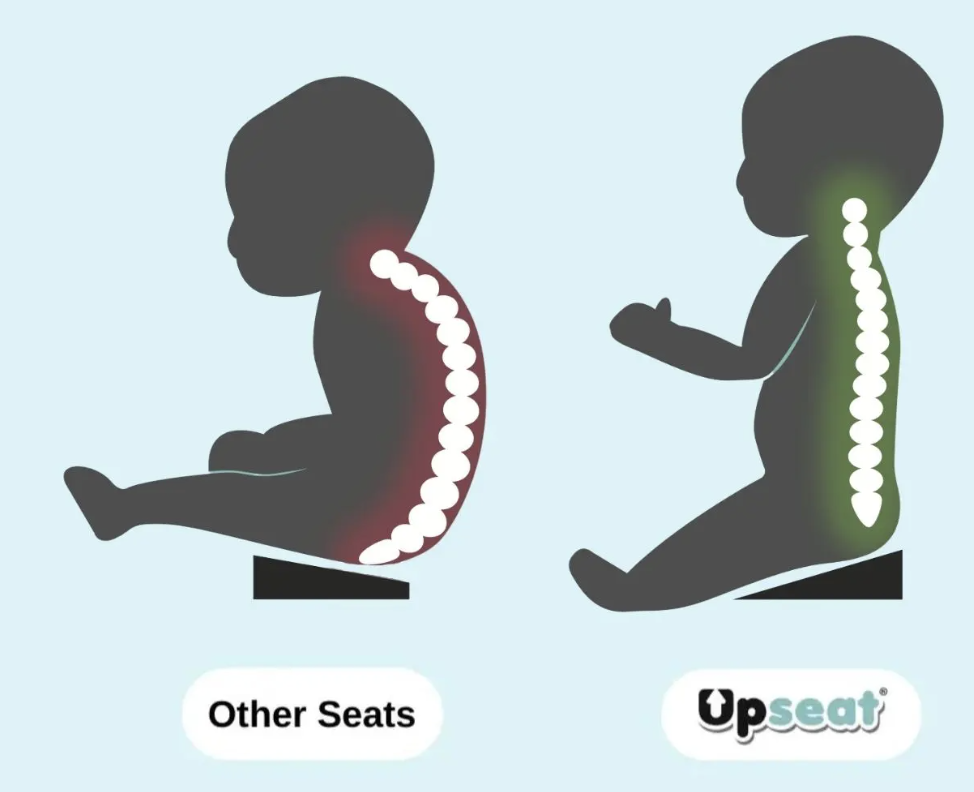
Anterior pelvic tilt — where the pelvis tilts slightly forward — allows the spine to adopt its natural S-curve. This is the position that the Upseat's patented wedge design achieves, and it is the position that pediatric PTs consistently recommend for seated baby positioning.
Hip Dysplasia Awareness (IHDI Guidelines)
The International Hip Dysplasia Institute (IHDI) recommends that baby products support the "M position" — where the hips are spread apart and the knees are higher than the buttocks. This position allows the femoral head to sit properly in the hip socket during the critical developmental window of the first 6 months.
Baby seats that force the legs together or position the hips in extension can interfere with healthy hip socket development. When evaluating any baby seat, look for:
Safe Usage Guidelines
Time Limit
Limit floor seat sessions to 20–30 minutes. Prolonged sitting in any container restricts movement and can delay motor development.
Supervision
Always supervise your baby in a floor seat. Never leave a baby unattended, even for a moment.
Tummy Time Balance
Floor seats should supplement — not replace — tummy time. Tummy time is essential for building the neck, shoulder, and core strength that supports healthy development.
Age Appropriateness
Introduce floor seats only when your baby can hold their head up steadily, typically around 3–4 months. Consult your pediatrician if you are unsure.
Posture Checks
Periodically check that your baby's posture looks upright and comfortable. If your baby is slumping significantly, they may not yet have the core strength for extended seated time.
Weight Limits
Always respect the manufacturer's weight limit. Exceeding the weight limit can compromise the structural integrity of the seat and the safety of your baby.
The Importance of Tummy Time
Tummy time is the single most important activity for infant motor development. It builds the neck, shoulder, and core strength that babies need to roll, sit, crawl, and eventually walk. The American Academy of Pediatrics recommends starting tummy time from day one, building up to 30 minutes or more per day by 3 months.
Floor seats are a useful tool for supervised seated play, but they should never come at the expense of tummy time. A healthy routine includes both — and the Upseat's ergonomic design means that when your baby is in the seat, their posture is actively supported rather than compromised.
"The Upseat aligns the spine beautifully and encourages amazing posture. It's one of the only containers I've used that I actually think completely exceeds the mark from a developmental perspective."